How to Choose Adhesive for Waterproof Labels: Surface, Water Exposure and End Use
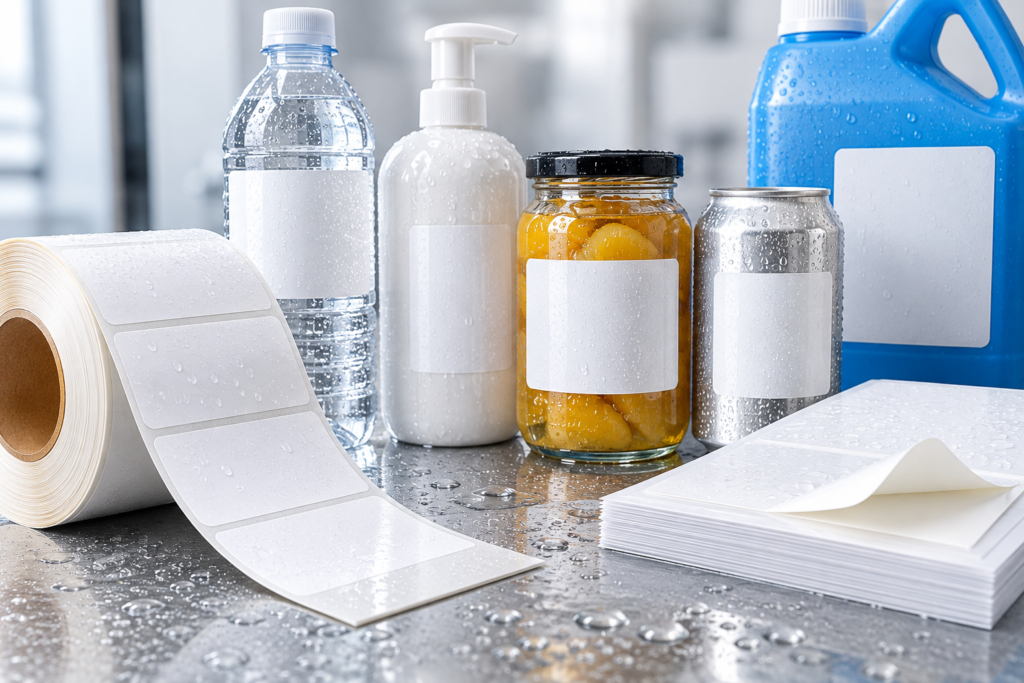
Waterproof label performance depends on more than the facestock. A PP or PET label film may resist moisture, but if the adhesive is not compatible with the receiving surface or application environment, the finished label can still lift, peel, or fail during use.
For label converters, packaging manufacturers, and self-adhesive material distributors, choosing the right adhesive for waterproof labels requires evaluating the complete label construction: facestock, adhesive, release liner, printing process, and end-use conditions.
This guide explains how to select waterproof self-adhesive labelstock based on surface compatibility, water exposure, temperature, and application requirements—and how to qualify a material before placing a bulk order.
Key Takeaways
- Waterproof facestock does not guarantee waterproof adhesive performance.
- PP and PE containers may require adhesives designed for low-surface-energy substrates.
- Condensation, cold application, and prolonged immersion are different exposure conditions.
- Permanent acrylic, rubber-based, and specialty adhesives have different performance profiles.
- Sample testing on the actual container is essential before bulk production.
- Label converters should specify the complete self-adhesive material construction when requesting quotations.
1. Understand the Complete Waterproof Label Construction
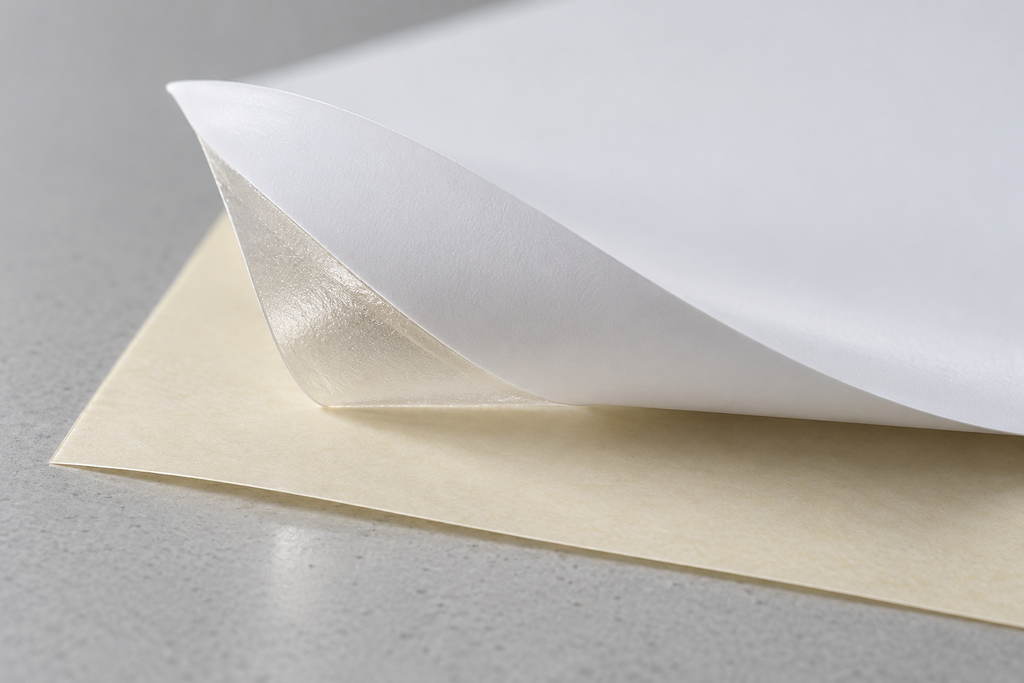
A self-adhesive label material normally consists of three main components:
Facestock: The printable surface, such as PP film, PET film, or another suitable synthetic material.
Pressure-sensitive adhesive (PSA): The bonding layer that attaches the label to the container or other receiving surface.
Release liner: The backing material that protects the adhesive before label application and supports dispensing and converting.
Each component affects the performance of the finished label.
For example, a PET facestock may provide good dimensional stability, but its adhesive must still be qualified for the intended container and environmental conditions.
Similarly, a flexible PP facestock may be suitable for curved packaging, but poor adhesive compatibility can cause edge lifting or peeling.
When sourcing waterproof self-adhesive labelstock, buyers should evaluate the entire construction rather than selecting the facestock and adhesive independently.
2. Choose Adhesive Based on the Application Surface
The receiving surface is one of the most important factors in adhesive selection.
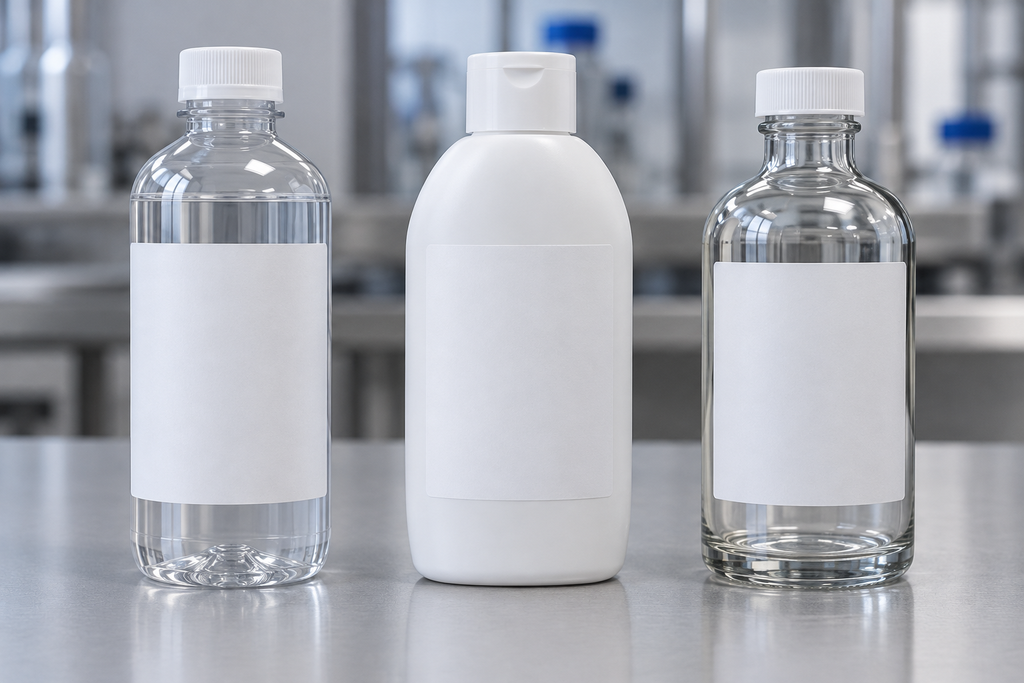
Different substrates vary in surface energy, texture, chemical composition, and flexibility. These properties influence how effectively a pressure-sensitive adhesive can wet out and bond to the surface.
Adhesive for PP and PE Plastic Containers
Polypropylene (PP) and polyethylene (PE) are commonly used in food packaging, personal-care bottles, detergent containers, and industrial packaging.
Both materials generally have relatively low surface energy, which can make adhesion more challenging than on clean glass or many metals.
For waterproof labels on PP and PE containers, consider:
- Adhesives formulated for low-surface-energy plastics
- Adequate initial tack and long-term peel adhesion
- Compatibility with container curvature and flexibility
- Surface contamination, additives, and possible chemical migration
- Application pressure and dwell time
A high-tack adhesive may improve initial contact, but it should not automatically be assumed to provide superior long-term durability.
Practical recommendation: Test the adhesive on the actual PP or PE container rather than relying only on generic plastic-substrate test data.
Adhesive for PET Bottles
PET bottles are widely used in beverage, cosmetic, and household packaging.
For waterproof labels on PET bottles, adhesive selection should account for refrigeration, condensation, surface curvature, and the intended label life.
A permanent acrylic adhesive may be appropriate for certain applications, but the exact formulation must be verified against the required exposure conditions.
Adhesive for Glass and Metal
Clean glass and many metal surfaces can provide favorable conditions for pressure-sensitive adhesive bonding.
However, moisture, oils, protective coatings, and surface contamination can reduce adhesion.
For glass beverage bottles or metal industrial containers, buyers should confirm whether the label will experience refrigeration, immersion, washing, or chemical exposure.
Adhesive for Curved and Squeezable Containers
Flexible containers introduce an additional challenge: the label must remain attached while the container changes shape.
The adhesive must maintain sufficient bonding, while the facestock should conform to the surface without excessive stress.
For squeezable bottles, a flexible PP or PE facestock may be worth evaluating alongside a compatible adhesive.
3. Match Adhesive Performance to Water Exposure
The term “waterproof label” covers several different application conditions.
A label exposed to occasional splashes may require a different adhesive from one applied to a wet bottle or submerged in an ice bucket.
Occasional Water Splashes
Examples include bathroom packaging, household cleaning products, and indoor containers.
A suitable permanent adhesive combined with waterproof facestock may be sufficient when the label is applied to a clean, dry surface and exposed only to occasional moisture.
Condensation and Refrigeration
Cold beverage bottles and refrigerated packaging can develop condensation.
If a label is applied directly to a damp container, water may interfere with adhesive contact.
Buyers should distinguish between:
- Labels applied dry and subsequently refrigerated
- Labels applied directly to cold, damp containers
The second situation may require a wet-application or cold-temperature adhesive specifically qualified for those conditions.
Water Immersion
Ice-bucket labels, reusable containers, and certain industrial applications may experience prolonged water contact.
For these applications, test whether the adhesive maintains acceptable peel strength and whether the facestock, ink, and protective coating remain intact.
Water-resistant performance under splashing conditions does not automatically establish suitability for prolonged immersion.
Washing and Chemical Exposure
Some containers are exposed to detergents, oils, sanitizers, or cleaning chemicals.
Chemical resistance must be evaluated separately from ordinary water resistance.
The adhesive, facestock, and printing system should be qualified for the actual chemicals, concentrations, temperatures, and exposure durations involved.
4. Acrylic vs. Rubber-Based Adhesive for Waterproof Labels
Acrylic and rubber-based pressure-sensitive adhesives are common adhesive families, but their properties vary substantially by formulation.
| Selection factor | Acrylic adhesive | Rubber-based adhesive |
|---|---|---|
| Initial tack | Depends on formulation | Often formulated for high initial tack |
| Long-term adhesion | Options available for durable applications | Depends on formulation and substrate |
| UV and aging resistance | Certain formulations offer strong resistance | Some formulations may require additional qualification |
| Low-surface-energy plastics | Specialty formulations may be required | Selected formulations can provide good initial bonding |
| Cold application | Requires an appropriately rated grade | Requires an appropriately rated grade |
| Water exposure | Must be qualified for the specific exposure | Must be qualified for the specific exposure |
Neither adhesive family is universally superior.
For B2B material selection, compare the actual technical data sheets and test results of candidate formulations rather than relying on adhesive family alone.
5. Application Temperature vs. Service Temperature
Two temperature specifications are particularly important when selecting waterproof label adhesive.
Application temperature refers to the temperature of the label and receiving surface when the label is applied.
Service temperature refers to the environmental temperature range the label experiences after application.
An adhesive may tolerate freezer storage after bonding but still require a warmer surface during initial application.
For refrigerated or frozen packaging, ask the supplier to confirm:
- Minimum application temperature
- Recommended application conditions
- Service temperature range
- Time required for adhesion development
- Compatibility with condensation or wet surfaces
For high-speed automatic labeling, temperature performance should be evaluated together with dispensing behavior, adhesive tack, and label flexibility.
6. Select the Right Facestock and Adhesive Combination
The facestock influences how the adhesive-backed label behaves during printing, dispensing, application, and use.
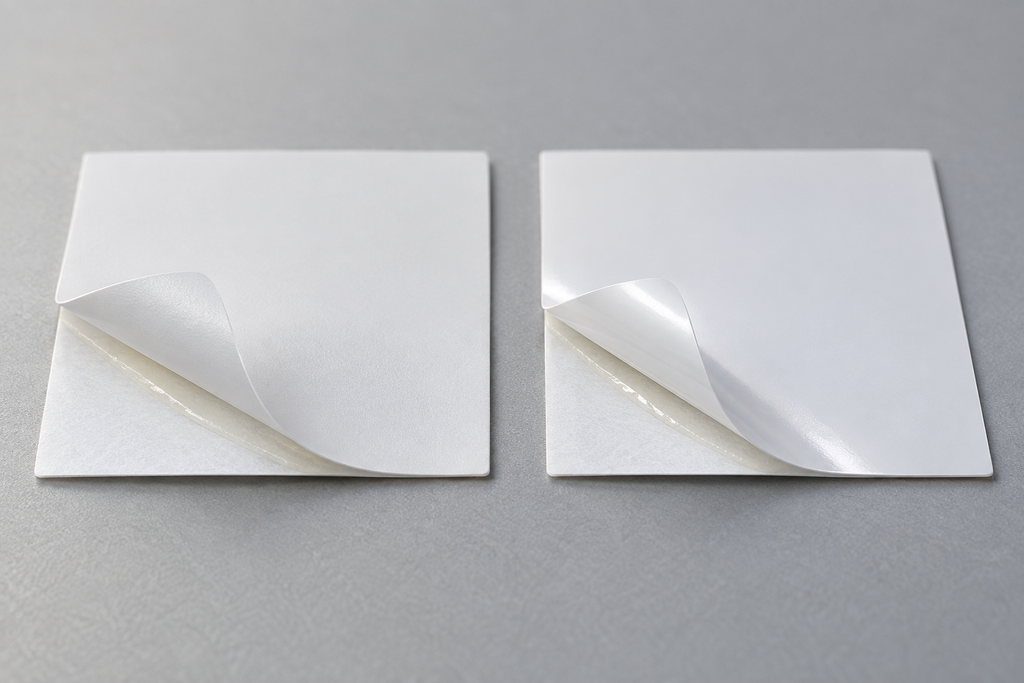
PP Self-Adhesive Label Materials
PP facestocks are commonly considered for product labels requiring moisture resistance, flexibility, and a smooth printable surface.
They may be suitable for beverage packaging, personal care, household products, and other applications, depending on the specific construction.
PET Self-Adhesive Label Materials
PET facestocks are often evaluated where dimensional stability, durability, and resistance to certain environmental stresses are important.
They may be suitable for industrial identification, durable product labels, and selected packaging applications.
PE Self-Adhesive Label Materials
PE facestocks can offer flexibility for certain curved or squeezable containers.
Their suitability depends on the film grade, adhesive, printing requirements, and container geometry.
Why Facestock Selection Affects Adhesive Performance
A rigid label material applied to a tightly curved container can generate restoring forces that encourage edge lifting.
A more conformable facestock may reduce this stress, but the adhesive must still provide adequate bonding.
The most suitable construction balances facestock flexibility, adhesive properties, printing compatibility, and end-use durability.
7. Test Waterproof Labelstock Before Bulk Production
For label converters and packaging manufacturers, sample qualification is an important step before approving large-volume orders.
Step 1: Define the Actual Receiving Surface
Record the container material, surface treatment, texture, and geometry.
Step 2: Specify Application Conditions
Identify application temperature, pressure, labeling speed, surface cleanliness, and any moisture present during application.
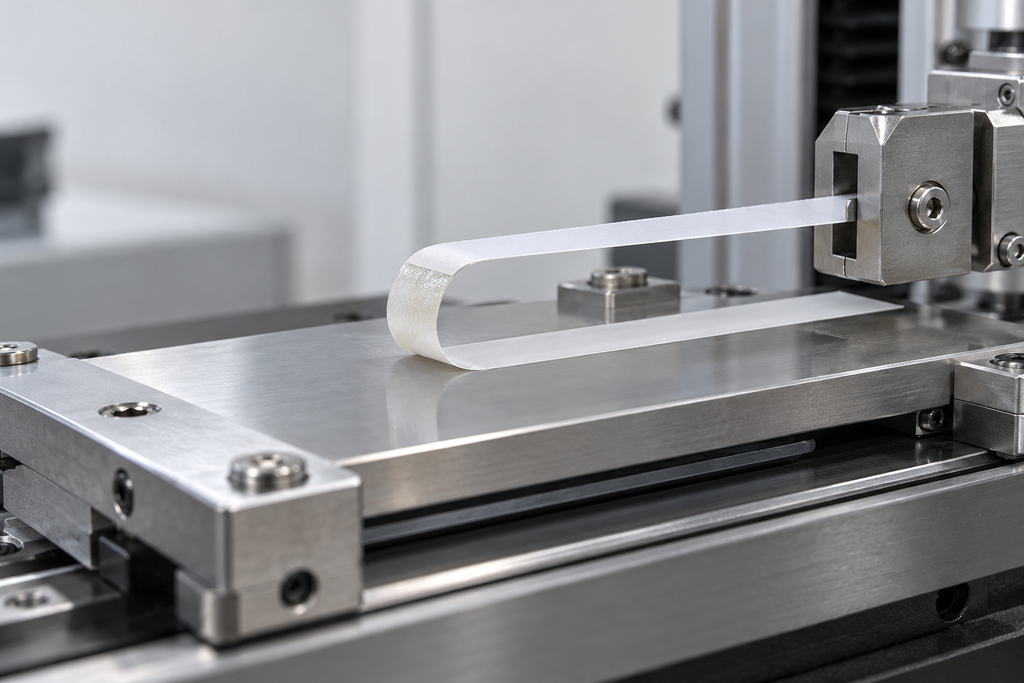
Step 3: Conduct Peel Adhesion Tests
Apply candidate labels under consistent conditions and evaluate peel adhesion after defined dwell periods.
A recognized pressure-sensitive label test method, such as a suitable FINAT peel adhesion procedure, may help establish consistent comparisons when applicable.
Step 4: Conduct Water Exposure Tests
Expose samples to representative splashing, condensation, immersion, or washing conditions.
Record edge lifting, adhesive failure, label distortion, and print damage.
Step 5: Evaluate Converting Performance
For roll-fed production, test die-cutting, matrix stripping, dispensing, liner release, and labeling stability.
Step 6: Document Acceptance Criteria
Record the approved material construction, test conditions, observed results, and any critical limitations.
A successful sample should represent the actual production process as closely as practical.
8. Common Adhesive Selection Mistakes
Selecting adhesive based only on initial tack. Strong initial contact does not guarantee reliable adhesion after prolonged water exposure or temperature changes.
Assuming all permanent adhesives are waterproof. Permanent bonding and resistance to water are separate performance requirements.
Ignoring container flexibility. Squeezable bottles and curved surfaces can create additional stress at label edges.
Using dry-application adhesive on wet containers without testing. Surface moisture may interfere with bonding.
Overlooking release liner compatibility. Even when the finished label performs well, unsuitable liner release or die-cutting behavior can create converting problems.
Skipping representative production trials. Laboratory performance alone does not guarantee trouble-free high-speed labeling.
9. B2B Purchasing Checklist for Waterproof Self-Adhesive Labelstock
When requesting a quotation from a self-adhesive material supplier, provide the following information.
| Specification | Information to provide |
|---|---|
| Facestock | PP, PET, PE, or other required material |
| Receiving surface | PP, PE, PET, HDPE, glass, metal |
| Adhesive requirement | Permanent, removable, high-tack, low-temperature |
| Water exposure | Splash, condensation, immersion, washing |
| Temperature | Application and service conditions |
| Printing process | Flexographic, UV, digital, or other process |
| Material format | Master rolls, slit rolls, or sheets |
| Dimensions | Width, length, core size, roll diameter |
| Purchasing volume | Trial quantity and estimated recurring demand |
| Documentation | Technical specifications and available test data |
Clear specifications help suppliers identify suitable material options and reduce unnecessary sampling cycles.
10. Sourcing Waterproof Self-Adhesive Materials from YISHU
For label converters, packaging manufacturers, and distributors, material consistency and technical compatibility are important considerations when sourcing waterproof self-adhesive labelstock.
YISHU supplies self-adhesive material solutions, including synthetic film-based options for packaging and industrial labeling applications.
Our team can discuss available facestock constructions, adhesive requirements, material formats, and sample evaluation based on your intended application.
Whether you are developing waterproof bottle labels, durable product identification labels, or industrial packaging labels, selecting the right material construction can help improve production reliability.
Frequently Asked Questions
What adhesive works best for waterproof labels on plastic bottles?
The appropriate adhesive depends on the plastic type, surface energy, curvature, temperature, and water exposure. PP and PE containers may require formulations specifically designed for low-surface-energy surfaces.
Is acrylic adhesive waterproof?
Certain acrylic pressure-sensitive adhesives can provide suitable resistance to water, but performance depends on the specific formulation and exposure conditions. Always confirm suitability through technical data and application testing.
Can waterproof labels be applied to wet bottles?
Some specialized adhesives are designed for cold or damp application conditions. Standard permanent adhesives should not be assumed suitable for wet surfaces without testing.
What is the difference between waterproof facestock and waterproof adhesive?
Waterproof facestock resists water-related damage to the label material itself. The adhesive must independently maintain an acceptable bond to the receiving surface under the required conditions.
Which self-adhesive label material is suitable for squeezable bottles?
Flexible PP or PE facestocks may be suitable, depending on the container and application. The adhesive must also maintain adequate adhesion during repeated deformation.
Can YISHU supply custom waterproof self-adhesive label material rolls?
Custom material requirements can be discussed with YISHU. Buyers should provide the facestock, adhesive requirements, roll dimensions, printing process, and estimated order quantity so available options can be evaluated.
Conclusion
Choosing adhesive for waterproof labels requires a systematic evaluation of surface compatibility, moisture exposure, temperature, and end-use requirements.
For label converters and packaging manufacturers, selecting the correct adhesive is only one part of the process. Facestock flexibility, liner compatibility, printing performance, and converting stability must also be considered.
By qualifying the complete self-adhesive label construction before bulk production, buyers can reduce the risk of label failure and improve material selection.
Need Waterproof Self-Adhesive Label Materials?
Looking for reliable self-adhesive labelstock for packaging or industrial applications? Tell us your facestock, adhesive requirements, application surface, roll dimensions and estimated order quantity. Our team will help you explore suitable material options.
Request Material Recommendations & Samples →