How to Choose Synthetic Paper Thickness for Printing Applications

How to Choose Synthetic Paper Thickness for Printing Applications
A synthetic paper sample may feel right in your hand but feed poorly through your press. A thicker menu may offer more body yet become difficult to fold. A lightweight tag may print well but fail around its attachment hole.
For commercial printers, converters and material distributors, selecting thickness is a production decision—not simply a choice between thin and thick stock.
The right specification must satisfy three conditions: it must suit the printing equipment, perform in the finished application and convert consistently.
This guide explains how to choose synthetic paper thickness for printing applications, compare microns with GSM and qualify samples before placing bulk orders.
Key Takeaways
- Specify thickness in microns and confirm the tolerance.
- Do not convert GSM to thickness without grade-specific information.
- Select the printable grade and thickness together.
- Check the exact press, feed path and duplex requirements.
- Test finished products, including folds, cut edges and attachments.
- Compare cost per acceptable finished piece rather than material price alone.
1. Understand Synthetic Paper Thickness: Microns, Mil and GSM
Synthetic paper specifications commonly use microns, millimetres, mil or GSM. These units describe different things.
| Unit | What It Measures | Example |
|---|---|---|
| Micron, or µm | Thickness | 150 µm |
| Millimetre, or mm | Thickness | 150 µm = 0.15 mm |
| Mil | One-thousandth of an inch | 1 mil = 25.4 µm |
| GSM, or g/m² | Mass per unit area | 150 GSM = 150 grams per square metre |
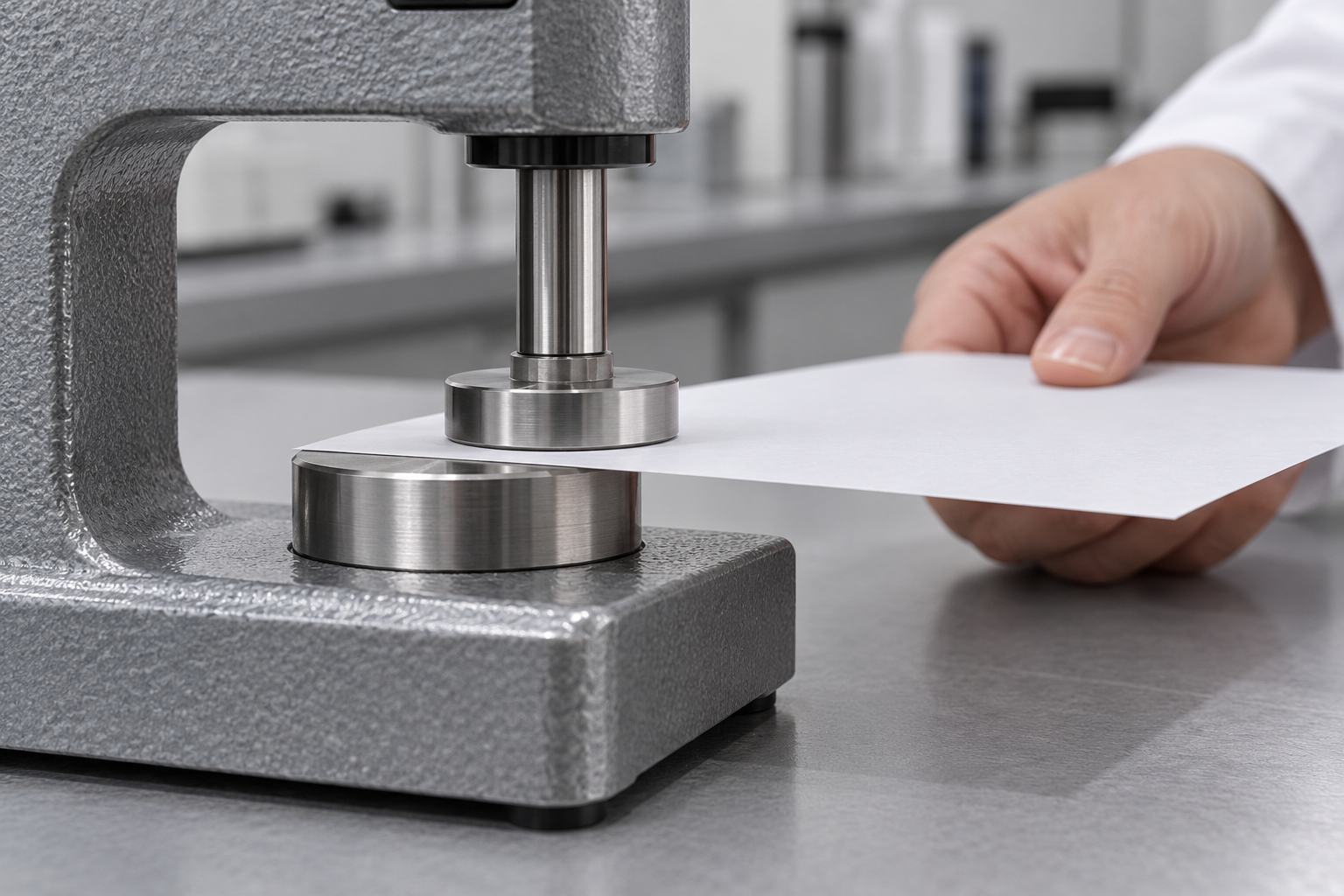
Mil does not mean millimetre. Confusing these units can result in an incorrect quotation or order.
Why GSM Does Not Directly Tell You Thickness
The relationship depends on the material’s apparent density and construction.
Base polymer, fillers, internal voids and surface layers can all influence the result. Two synthetic papers with the same GSM may therefore have different thicknesses and handling characteristics.
When replacing an existing stock, provide both its thickness and GSM where available. A physical reference sample is even more useful.
Avoid requesting “the synthetic equivalent of 200 GSM paper” without explaining the required stiffness, application and printing process.
2. Choose the Material Grade Before Finalizing Thickness
Thickness is only one part of the specification.
PP and PET synthetic papers can differ in density, stiffness, flexibility and processing behaviour. Surface treatments also affect which printing systems a grade can accept.
Even within one polymer family, equal thickness does not establish equal performance.
Ask the supplier to identify:
- Base material and exact grade.
- Nominal thickness and tolerance.
- GSM.
- Surface finish and printable sides.
- Compatible printing processes.
- Available stiffness and dimensional-stability data.
A stock suitable for UV printing should not automatically be assumed suitable for aqueous inkjet, dry toner or HP Indigo.
Shortlist the correct grade and thickness together.
3. Synthetic Paper Thickness by Application: Where to Start
The following ranges are illustrative starting points for sample trials, not universal specifications or a statement of YISHU stock availability.
Select samples within the limits of your equipment and validate the finished product.
| Printing Application | Illustrative Thickness Range to Evaluate | Main Trade-Off |
|---|---|---|
| Foldable maps and compact instruction sheets | 80–150 µm | Flexibility, folded bulk and crease behaviour |
| Flexible menus and document pages | 100–200 µm | Handling, readability and binding or folding |
| Loose menus, covers and small display inserts | 150–250 µm | Body, flatness and equipment compatibility |
| Hangtags and reusable identification pieces | 150–300 µm | Stiffness, attachment strength and cutting |
| Cards and more rigid printed pieces | 200–350 µm | Handling feel, stack height and converting |
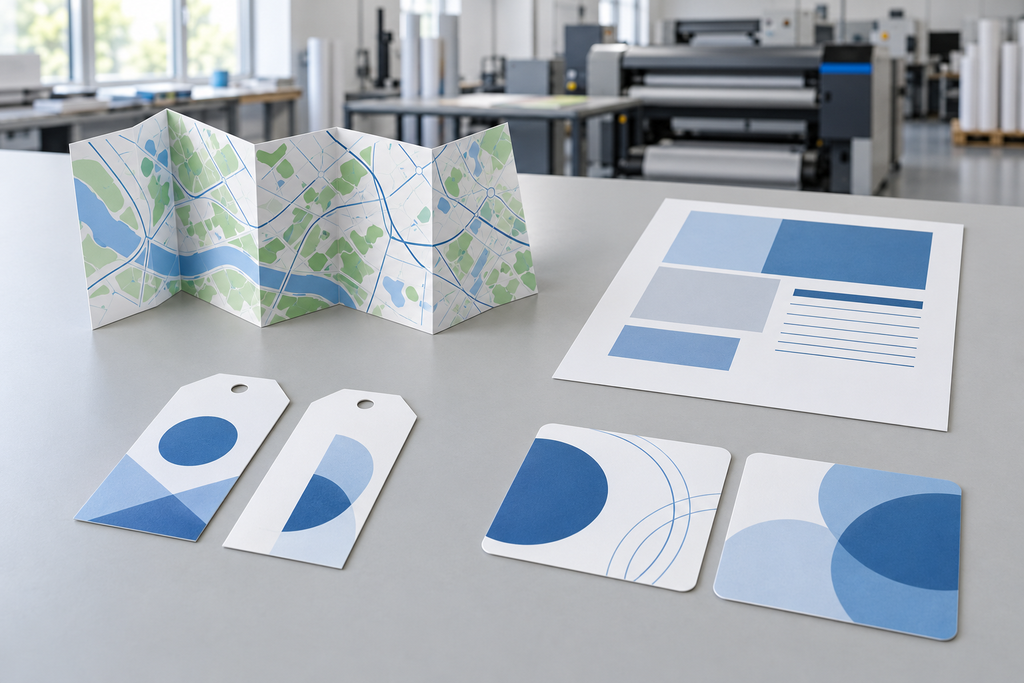
Applications overlap these ranges. A large menu may need different stiffness from a small menu, while a tag’s hole design can matter more than a modest thickness increase.
If possible, compare two or three nearby thicknesses within the same material family.
4. Check Printer Limits Before Ordering Samples
A press accepting a particular paper weight does not necessarily accept every synthetic material of similar thickness.
Check the current documentation for the exact machine and configuration, including:
- Permitted synthetic media.
- Minimum and maximum thickness.
- Sheet size or roll dimensions.
- Approved feed source.
- Simplex and duplex restrictions.
- Drying, curing or fusing conditions.
- Required media settings.
For example, Canon documentation for certain imagePRESS models directs users to consult their dealer or service representative before using PP or polyester synthetic papers. This illustrates why a general paper specification is insufficient to approve a synthetic grade. oip.manual.canon
Sheet-Fed Printing
Evaluate sheet separation, stiffness, flatness and behaviour through the complete paper path.
A stock that runs in simplex mode may behave differently during duplex printing. Include the second pass in the trial.
Roll-Fed Printing
Confirm total material thickness, roll diameter, core size, winding quality and tension requirements.
Check whether the material tracks consistently and remains flat through printing, curing and rewinding.
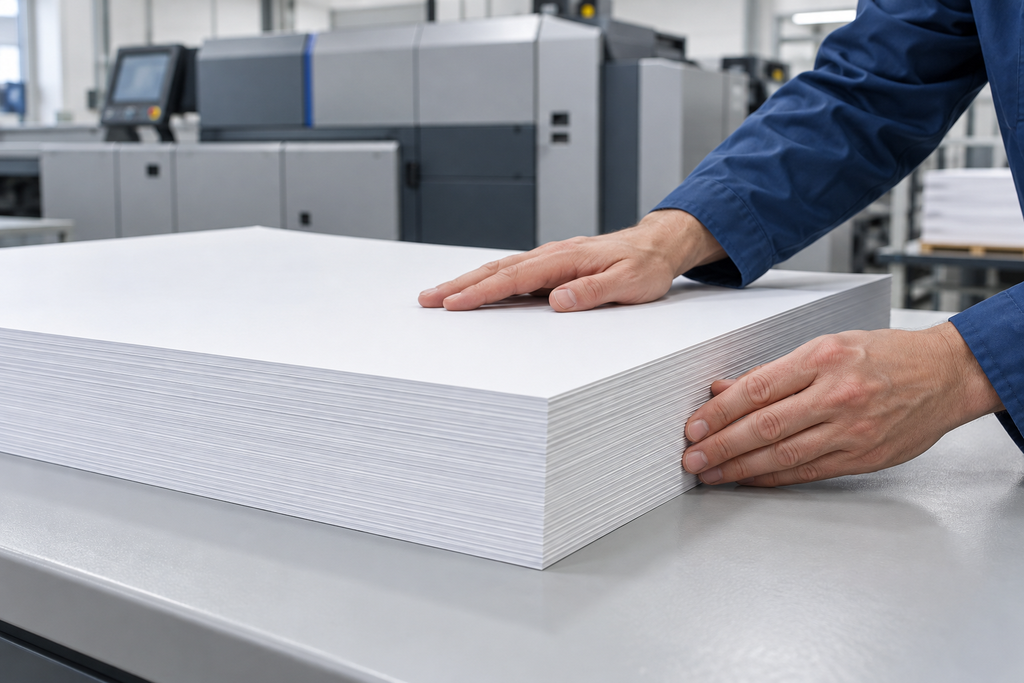
Do not purchase bulk material based only on a printer’s maximum GSM rating.
5. Match Thickness to the Finished Product’s Main Risk
Synthetic Paper Thickness for Menus
Start with the menu format: a loose sheet, folded piece, bound booklet or insert.
For loose menus, evaluate body and resistance to permanent deformation. For folded menus, check crease appearance and whether the menu closes comfortably.
Test the actual printed surface against the intended cleaning method. Increasing thickness will not correct ink that rubs off during wiping.
Synthetic Paper Thickness for Foldable Maps
A map must remain usable after repeated folding.
Assess folded size, crease intersections and readability along folds. Thicker stock increases folded bulk and may require changes to the folding process.
Define a representative folding sequence and inspect both the material and printed image.
Synthetic Paper Thickness for Tags
Check the attachment area.
Use the actual hole diameter, edge distance and fastener. If a tag tears at its hole, evaluate the design and reinforcement options alongside thickness.
Synthetic Paper Thickness for Cards
Define the required handling characteristics.
Assess bending resistance, recovery, surface friction, cut edges and stack height. For double-sided cards, evaluate opacity separately: added thickness alone does not guarantee that reverse-side artwork remains concealed.
6. Include Finishing in the Thickness Decision
A printed flat sheet is an intermediate product. Approval should include the operations that follow.
| Finishing Process | What to Check |
|---|---|
| Cutting and die-cutting | Edge quality, distortion and dimensional accuracy |
| Folding and creasing | Fold geometry, whitening, cracking and image damage |
| Punching | Hole quality and resistance to attachment loads |
| Binding | Page turning, hole condition and movement |
| Lamination | Bonding, curl, total thickness and finished flexibility |
| Adhesive assembly | Bond formation, surface compatibility and flatness |

Scoring or creasing may help certain thicker grades, but tooling and methods must suit the exact material. Manufacturer guidance for specific synthetic-paper products likewise treats folding and preliminary trials as grade-dependent considerations. yupo.com
If a finishing problem occurs, investigate tooling and process settings before assuming a thickness change will solve it.
7. Specify Thickness Tolerance and Consistency
“200 microns” is incomplete without a tolerance.
Ask how thickness is measured and what variation is permitted within a sheet, across a roll and between deliveries.
For coated or multilayer grades, confirm whether the quoted figure describes the base material or the complete printable construction.
Also agree on:
- Sheet flatness or roll curl.
- Finished dimensions.
- Surface identification, where sides differ.
- Packaging and storage instructions.
- Notification of changes to construction or treatment.
Do not substitute a stack measurement for an agreed single-sheet measurement method.
Retain approved samples and their grade identification as references for repeat purchases.
8. Run a Production-Representative Thickness Trial
Request enough material to evaluate feeding and converting, rather than relying only on hand-sized swatches.
Step 1: Select Comparable Samples
Compare candidate thicknesses with similar construction and printable surfaces. Otherwise, differences may come from the grade rather than thickness.
Step 2: Print Representative Artwork
Include solid areas, fine text, pale backgrounds and functional codes where relevant. Test both sides if required.
Step 3: Record Production Behaviour
Monitor feeding interruptions, registration, curl, output stacking and usable yield.
Step 4: Complete the Finishing Process
Cut, fold, punch, bind or laminate using production-representative methods.
Step 5: Test Actual Use
Evaluate handling, cleaning, moisture exposure or attachment conditions relevant to the product.
Approve the material only after the finished sample meets the agreed requirements.
9. Compare Cost per Usable Finished Piece
Thicker material can increase material mass, freight and finished-product bulk. However, the lowest-priced grade may cost more if it produces excessive rejects.
Compare:
- Price per square metre or usable sheet.
- Layout yield.
- Setup and production waste.
- Printing and finishing speed achieved in trials.
- Additional protective finishing.
- Packing and transport requirements.
For the same formulation and density, increasing thickness from 150 to 200 µm increases theoretical material volume—and approximately mass—by one-third. This comparison does not apply directly across grades with different densities.
The purchasing target is the lowest total cost that consistently meets the finished-product specification.
10. What to Send When Requesting Synthetic Paper Samples
| Information | Details to Provide |
|---|---|
| Application | Menu, map, tag, card, manual or display insert |
| Finished dimensions | Size, layout and folding requirements |
| Current material | Grade, thickness, GSM and sample if available |
| Printing equipment | Exact press or printer model |
| Printing process | Ink system, printable sides and duplex sequence |
| Finishing | Cutting, folding, punching, binding or lamination |
| Main problem | Misfeeds, excessive flexibility, curl, tearing or show-through |
| Supply format | Sheet dimensions or roll width, length and core |
| Purchase requirement | Trial quantity, expected bulk volume and destination |
Describing the current problem helps a supplier propose a useful comparison—not simply the next thicker material.
Frequently Asked Questions
What thickness of synthetic paper is best for printing?
There is no universal thickness. Select a grade compatible with your equipment, then evaluate candidate thicknesses against the finished application and converting requirements.
Is 150 µm synthetic paper the same as 150 GSM?
No. Microns measure thickness; GSM measures mass per unit area. Their relationship depends on the exact material construction and density.
Is thicker synthetic paper always more durable?
No. Finished durability also depends on the material, printed surface, cut geometry and conditions of use. Thickness will not automatically solve poor ink adhesion or attachment design.
Can synthetic paper run through any digital printer?
No. Confirm compatibility with the specific machine, ink or toner system and processing conditions before testing.
Should PP and PET synthetic paper be compared at the same thickness?
Equal thickness is a useful reference, but it does not establish equal stiffness, mass or performance. Compare the finished samples and relevant technical data.