PP vs PET Label Material: How to Choose for Durability, Containers and Outdoor Use
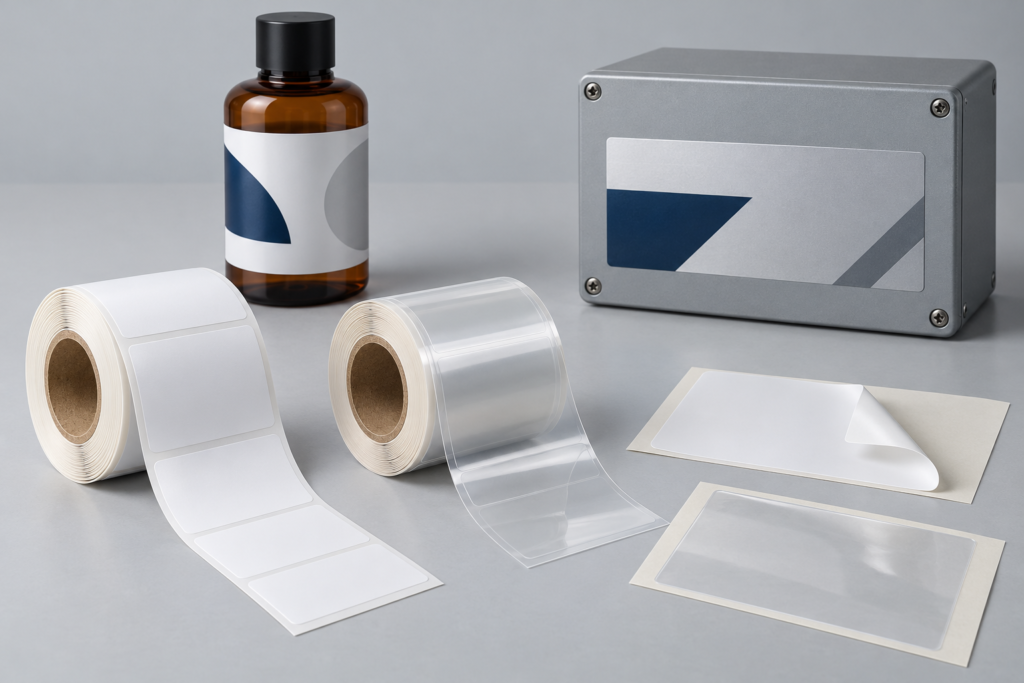
A label may look perfect immediately after application, then lift at the edges, lose its print or become unreadable during use. These failures can interrupt production, create rework and damage the appearance of an otherwise well-made product.
Choosing between PP and PET label material is an important step, but the film alone does not determine performance. The adhesive, printable coating, ink, protective finish and application conditions must work together.
For packaging buyers and label converters, the practical question is:
Which label construction will remain attached, readable and visually acceptable throughout the product’s intended life?
This guide explains how to compare polypropylene and polyester label materials for containers, demanding environments and outdoor applications.
1. PP vs PET Labels: What Is the Main Difference?
PP labels use polypropylene film as the face material. Biaxially oriented polypropylene, commonly called BOPP, is widely used for product packaging labels.
PET labels use polyester film as the face material. They are commonly considered for applications requiring greater dimensional stability or resistance to demanding service conditions.
Material suppliers generally position PP films for rigid-container packaging and PET films for more demanding industrial applications. However, individual grades can differ significantly. A material family name does not replace a technical specification.
PP vs PET Label Material Comparison
| Selection factor | PP label material | PET label material |
|---|---|---|
| Common applications | Cosmetics, household products, food and general packaging | Equipment identification, durable product marking and industrial labels |
| Appearance | White, clear and metallized constructions are available | White, clear and metallized constructions are available |
| Container fit | Common starting point for rigid packaging; conformability depends on grade and thickness | Often selected for stable surfaces; tight curves require careful testing |
| Heat exposure | Check the limits of the complete construction | Often considered where higher heat resistance is required; verify the grade |
| Moisture exposure | Suitable constructions are available for damp packaging environments | Suitable constructions are available for demanding moisture exposure |
| Chemicals and abrasion | Performance depends on coating, print and protection | Often shortlisted for demanding exposure, with qualified print and protection |
| Outdoor use | Requires a specifically qualified construction | Frequently shortlisted for durable outdoor labels, but not automatically weatherproof |
| Purchasing decision | Evaluate packaging performance and converting cost | Evaluate required durability against the additional construction cost |
Use this table to shortlist samples, then qualify the finished label on the actual product.
2. Specify the Complete Self-Adhesive Label Construction
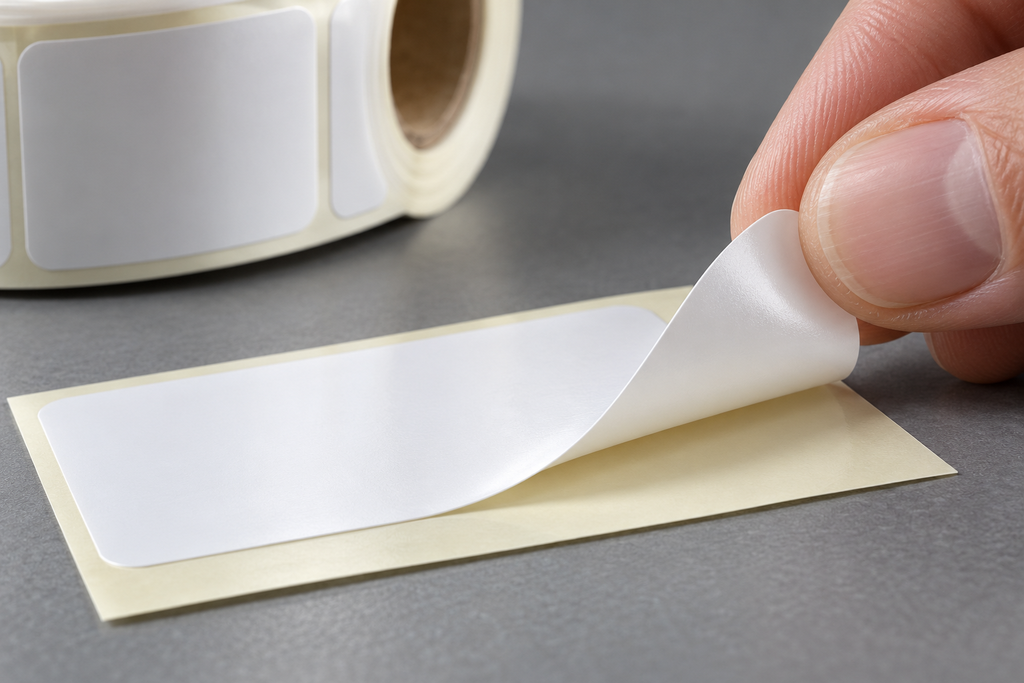
A self-adhesive label is more than a PP or PET film.
Its construction normally includes:
- A face film.
- A print-receptive surface treatment or coating.
- A pressure-sensitive adhesive.
- A release liner.
- Printed inks, toner or thermal-transfer ribbon.
- An optional varnish or protective laminate.
Each layer has a different job.
If the printed image rubs off but the label remains attached, the problem may involve ink adhesion, curing or surface compatibility. If an intact label lifts from the container, investigate the adhesive, surface condition, geometry and application process.
Changing from PP to PET may not solve either problem.
When requesting samples, identify whether you need printable face film, self-adhesive roll stock or finished printed labels. These are different purchasing specifications.
3. How to Choose Label Material for Plastic Containers
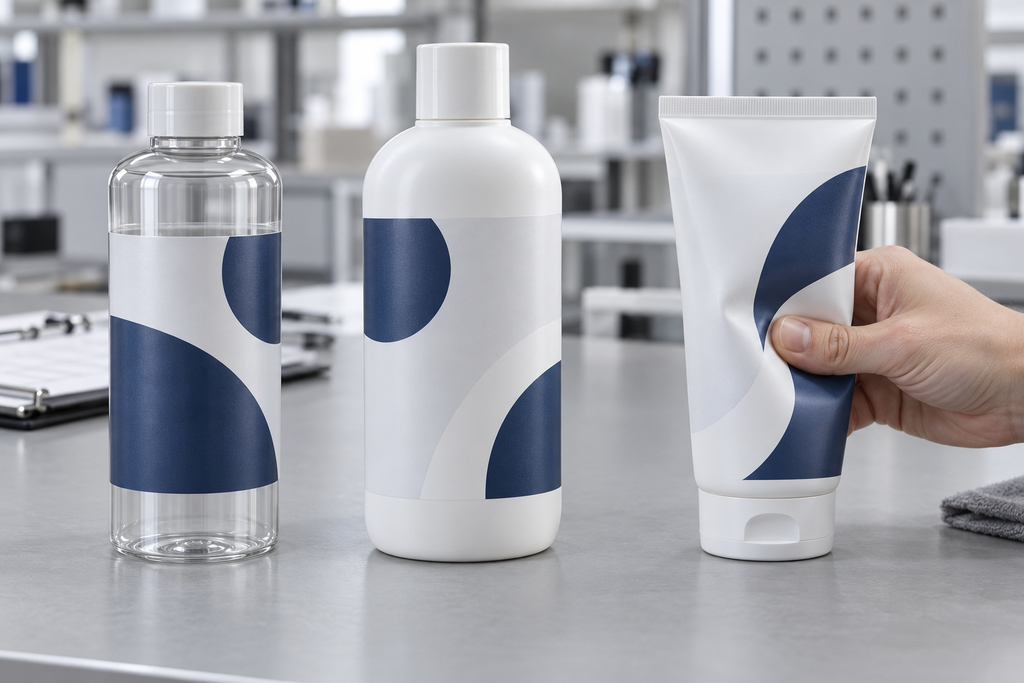
Rigid PET Bottles and Glass Containers
PP film is often a practical starting point for rigid bottles and jars when moisture resistance, print appearance and packaging economics are priorities.
For clear labels, evaluate more than film transparency. Adhesive clarity, trapped air, application quality and the container surface all affect the final appearance.
Inspect samples after filling and storage, particularly if the product will experience refrigeration or condensation.
A PET bottle does not automatically require a PET label. The container resin and the label face material have separate functions.
HDPE and PP Containers
For HDPE bottles and PP containers, adhesive selection deserves particular attention. These plastics can be challenging bonding surfaces, and a general-purpose adhesive may not suit every application.
Provide the supplier with:
- The actual container resin and surface finish.
- Whether the surface is treated, textured or coated.
- Label dimensions and application position.
- Application temperature.
- Exposure to moisture, oils or product leakage.
- Any known surface contamination or mold-release residue.
Test on production containers rather than relying only on smooth laboratory panels.
A PET face film with an unsuitable adhesive can still peel from an HDPE container.
Squeezable Bottles and Flexible Packaging
Do not assume that every PP label is suitable for repeated squeezing.
Film orientation, thickness, label size and adhesive behavior affect how a label moves with a flexible container. Standard BOPP and a purpose-designed conformable film can behave differently.
For heavily squeezable bottles, include a suitable PE or other conformable film construction in the evaluation. Manufacturers specifically offer PE film labels for flexible and squeezable packaging.
Test the filled package through repeated squeezing and recovery. Check for wrinkles, cracks, tunneling and edge lift.
Small-Diameter and Tightly Curved Containers
A label that performs well on a flat surface may lift when wrapped around a small bottle.
The film’s stiffness, adhesive bond, label dimensions and curvature interact. A thicker construction may increase the tendency to spring away from the surface.
For small containers, compare candidate constructions on the actual diameter and allow the specified adhesive bond-development time before evaluating performance.
4. PP vs PET Labels for Outdoor Use
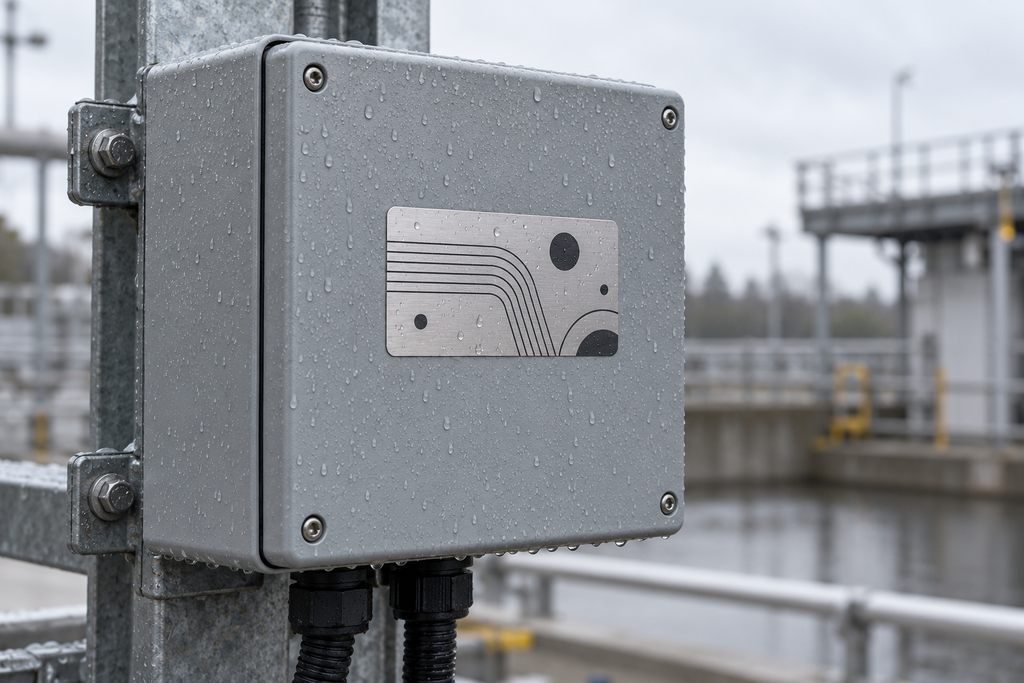
Outdoor exposure is not a single condition.
An equipment label under a protective cover faces different demands from a label exposed to direct sunlight, rain, cleaning chemicals and repeated abrasion.
Before selecting an outdoor label material, define:
| Exposure factor | Information to specify |
|---|---|
| Required service life | The period for which attachment and readability must be maintained |
| Sunlight | Direct or shaded exposure; installation location |
| Temperature | Minimum, maximum and cycling conditions |
| Water | Rain, condensation, immersion or pressure washing |
| Chemicals | Substance, concentration, contact time and cleaning method |
| Mechanical wear | Handling, rubbing, scraping or contact with tools |
| Application surface | Metal, painted surface, glass or a specific plastic |
| Readability | Required text, warning information and barcode performance |
PET is often worth evaluating for demanding outdoor identification. However, a polyester film is not an outdoor-life guarantee.
Avery Dennison notes that outdoor label performance changes with the application substrate and protective laminate or coating. Its guidance also emphasizes weathering evaluation for the intended construction.
Avoid accepting a general statement such as “PET lasts five years outdoors” without supporting conditions and construction details.
Ask whether the evidence applies to:
- The same face film and adhesive.
- The proposed printing system.
- The same protective finish.
- A comparable application surface.
- The required climate and exposure conditions.
Accelerated weathering can help compare candidates, but test hours should not be converted directly into service years without a supported correlation.
5. Waterproof Labels: Why Film Selection Is Only the Start
Both PP and PET films can form part of a water-resistant label construction. However, resistance to water at the film level does not prove that the finished label will survive wet service.
A label may remain physically intact while:
- The adhesive loses its bond.
- The ink smears or transfers.
- A coating whitens.
- A laminate separates.
- A barcode becomes unreadable.
Also distinguish between application conditions and service conditions.
A label applied to a dry container before refrigeration faces a different challenge from one applied directly to a cold, wet bottle.
For refrigerated packaging, freezer use or wet processing, specify when labeling occurs and the condition of the surface at that moment.
6. Printing on PP and PET Label Materials
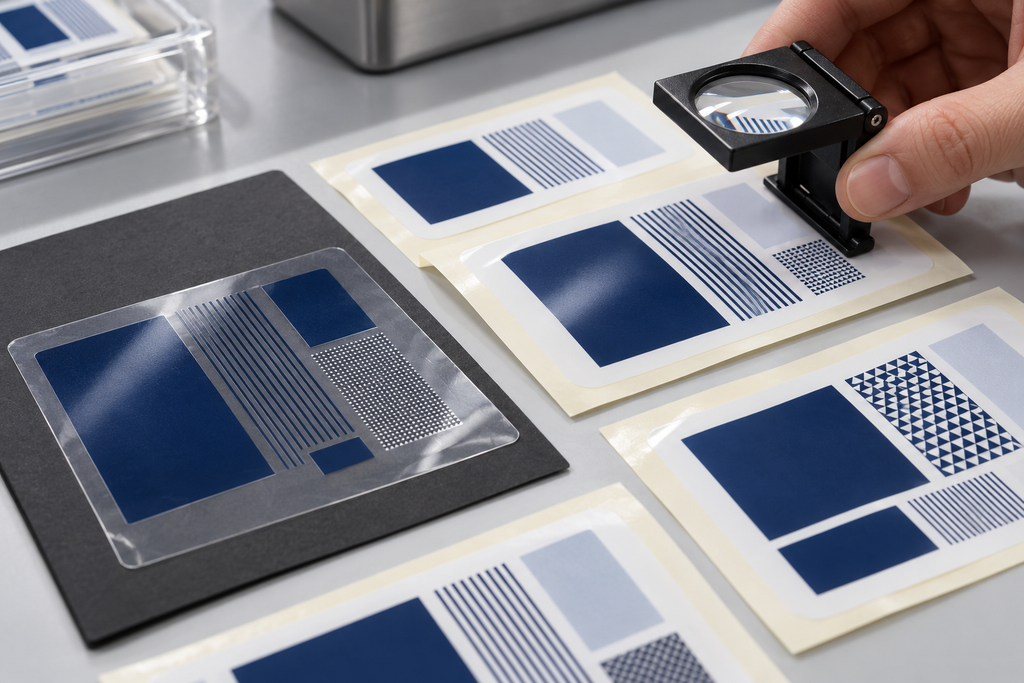
“Printable PP” and “printable PET” are incomplete specifications.
A grade designed for one process may not suit another. Confirm compatibility with the actual equipment and consumables.
| Printing process | What buyers should confirm |
|---|---|
| Flexographic printing | Surface treatment or coating, ink system, drying or curing conditions |
| UV inkjet printing | Approved printable surface, ink adhesion, curing and post-print flexibility |
| Aqueous inkjet printing | A suitable ink-receptive coating for the specific ink type |
| Dry-toner printing | Qualified media construction, fusing compatibility and feeding requirements |
| Liquid-toner printing | Suitable preparation or coating for the specified press |
| Thermal-transfer printing | Face coating, ribbon combination and required image durability |
Do not place a self-adhesive film construction in a heat-fusing printer simply because it is described as PP or PET. The face film, adhesive and liner must all be suitable for that process.
Test the Artwork That Matters
Use production-representative artwork containing:
- Fine text and reverse text.
- Solid color areas.
- Brand-critical colors.
- Barcodes or variable data.
- Areas exposed to handling or cleaning.
Assess the print after the required drying, curing or conditioning interval. For durable identification, check readability again after environmental exposure.
7. Troubleshooting Common PP and PET Label Failures
| Observed problem | Factors to investigate | Useful next step |
|---|---|---|
| Edges lift on a bottle | Adhesive suitability, curvature, film stiffness, contamination | Trial candidate constructions on the production container |
| Labels wrinkle during squeezing | Insufficient conformability, label size, container movement | Compare a construction designed for flexible packaging |
| Ink rubs off | Coating compatibility, ink or ribbon selection, curing | Run a defined print-adhesion and rub evaluation |
| Label lifts after refrigeration | Application temperature, condensation, adhesive selection | Reproduce the actual labeling and cooling sequence |
| Outdoor graphics fade | Ink weatherability, exposure and protective finish | Evaluate the complete printed construction |
| Label distorts near heat | Film, adhesive, print or laminate limits | Test at the actual operating temperature and duration |
| Clear label appears cloudy | Adhesive optics, moisture, trapped air, surface texture | Inspect applied samples before and after conditioning |
A useful failure report identifies what failed and when, rather than simply stating that the material was unsuitable.
8. Converting Checklist for Label Printers and Roll Buyers
For converters, application durability is only part of the decision. The material must also print, die-cut, strip and dispense reliably.
Before ordering PP or PET self-adhesive label rolls, confirm:
- Face-film type, thickness and finish.
- Adhesive reference and intended application.
- Liner material, thickness and release characteristics.
- Roll width, core size and maximum outside diameter.
- Winding direction and print-side orientation.
- Splice limits and identification requirements.
- Die-cutting and matrix-stripping performance.
- Dispensing performance at the intended line speed.
- Storage conditions and usable shelf life.
A stronger film is not automatically easier to convert. Tooling, die condition, liner protection and the shape of the waste matrix can all affect yield.
Compare cost per accepted label or successfully labeled product, including waste, downtime and rework.
9. How to Test PP and PET Label Samples Before Bulk Orders

A small, structured trial can prevent a much larger production problem.
Step 1: Use Actual Containers
Include the real surface finish, diameter and filling condition. Where relevant, test more than one container production lot.
Step 2: Print and Finish as Intended
Use the planned press, ink or ribbon and protective finish. Hand-prepared samples may not represent production performance.
Step 3: Apply Under Representative Conditions
Record surface preparation, application temperature, pressure and adhesive bond-development time.
Step 4: Reproduce the Main Service Exposures
Select relevant trials such as refrigeration, water exposure, temperature cycling, squeezing, rubbing or contact with the actual cleaning agent.
Define exposure conditions before testing.
Step 5: Agree on Acceptance Criteria
Examples include:
- No unacceptable edge lift or bubbling.
- Print remains legible.
- Barcode meets the agreed verification requirement.
- No unacceptable cracking, distortion or delamination.
- Appearance remains within the approved reference.
Use repeat samples and retain an unexposed control. Visual screening is useful, but it should not be presented as certification or proof of an untested service life.
10. What to Send When Requesting a PP or PET Label Material Quotation
A detailed inquiry helps suppliers recommend relevant samples and quote the correct construction.
| RFQ item | Details to provide |
|---|---|
| Product application | Cosmetic bottle, household container, equipment label or another use |
| Container | Material, dimensions, surface finish and flexibility |
| Label | Dimensions, shape, white or clear appearance |
| Printing | Press model, process, ink, toner or ribbon |
| Application conditions | Temperature, surface dryness and manual or automatic application |
| Service environment | Indoor or outdoor, moisture, chemicals, heat and abrasion |
| Required life | Expected period of attachment and readability |
| Finishing | Varnish, laminate or other protection |
| Supply format | Face film or self-adhesive material; rolls or sheets |
| Quantity | Trial requirement, initial order and expected repeat demand |
If a current label is failing, include photographs and describe the exposure sequence. A failed sample can be more informative than a request for a “stronger material.”
Frequently Asked Questions
Is PET label material always better than PP?
No. PET may be appropriate for demanding industrial conditions, while PP may meet a packaging application’s requirements at a more suitable total cost. Select against the required performance rather than the polymer name alone.
Can PP labels be used outdoors?
Some specifically qualified PP constructions may suit the required outdoor application. Confirm the intended service life, exposure conditions, printing system and supporting test evidence.
Are PET labels waterproof?
PET film can be part of a water-resistant construction. The adhesive, printed image and any protective finish must also withstand the intended exposure.
Which label material is suitable for HDPE bottles?
Start with an adhesive qualified for the actual HDPE surface, then select a face film that suits the container shape and flexibility. PP, PET and conformable alternatives should be evaluated according to the application.
Need Help Choosing PP or PET Label Material?
Tell YISHU about your container, printing process and service environment. We can discuss material options and sample availability for your label application.
Please include your label size, container material, indoor or outdoor use, expected exposure conditions and estimated quantity.
Request Label Samples & a Quotation