What Is Synthetic Paper? A Practical Guide for Printers and Converters
A restaurant menu may need to survive repeated wiping. An outdoor map must remain readable after rain and folding. An industrial tag needs to retain its printed information through handling, storage, and transport.
For printers and converters, these applications require more than an attractive printing surface. The substrate must work with the printing equipment, perform consistently during finishing, and withstand its intended service conditions.
Synthetic paper can meet many of these needs, but choosing it involves more than asking for a waterproof material. Different grades have different surface characteristics, printing requirements, and converting behavior.
This guide explains what synthetic paper is, where it is used, and how to evaluate it before ordering rolls or sheets.
Key Takeaways
- Synthetic paper is a polymer-based printing material. Common options include polypropylene (PP) and polyester (PET), with performance that varies by grade and construction.
- A water-resistant substrate does not guarantee durable printing. The ink, coating, adhesive, and converted features must also withstand the application.
- Printing compatibility is grade-specific. Match the material to the press, ink or toner system, and finishing process.
- Test representative samples before buying in bulk. Evaluate the printed and converted item rather than the blank material alone.
What Is Synthetic Paper?
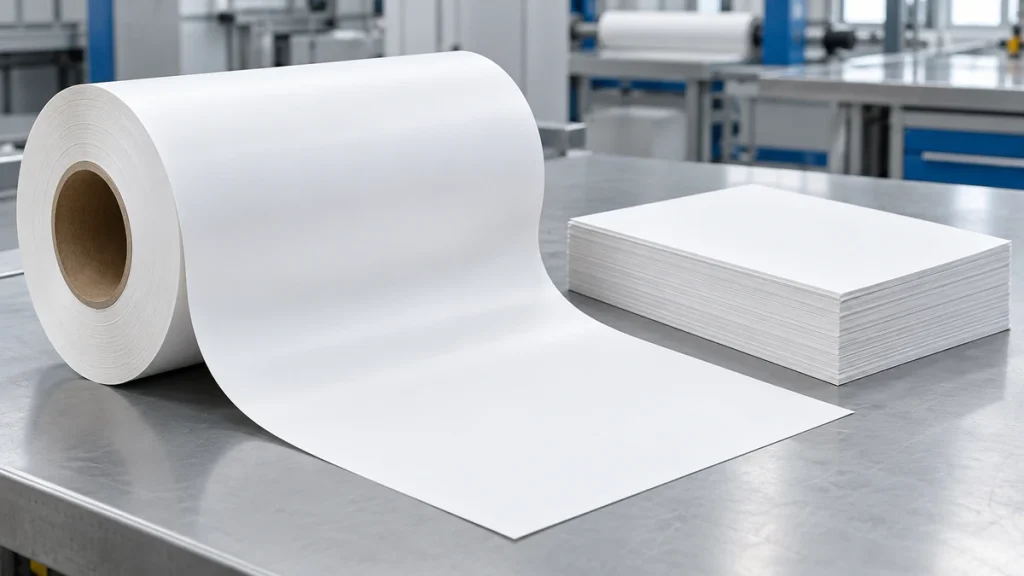
Synthetic paper is a polymer-based substrate engineered to provide a paper-like appearance and printable surface, together with properties such as water resistance and improved tear resistance.
Conventional paper is generally made from cellulose fibers. Many synthetic papers instead use polymers such as polypropylene or polyester. Depending on the grade, they may also incorporate mineral fillers, surface treatments, or functional coatings.
These components influence properties such as opacity, stiffness, ink adhesion, and handling.
Synthetic paper is therefore a material category rather than a single specification. Two white sheets with a similar appearance may perform differently on the same press.
For buyers, the important question is not simply whether a material is synthetic paper. It is whether the specific grade fits the printing process and finished application.
What Is Synthetic Paper Made Of?
PP and PET are two material families commonly encountered in commercial printing and converting. Polymer composition helps narrow the selection, but the surface construction and grade remain essential.
PP Synthetic Paper (Polypropylene): Properties and Uses
PP synthetic paper is used for printed products such as menus, maps, tags, manuals, and display graphics.
Its flexibility, opacity, stiffness, and tear behavior depend on the formulation, manufacturing process, and thickness. A flexible grade suitable for a foldable map may not provide the rigidity needed for a display card.
The printable surface also matters. A grade developed for offset printing should not automatically be treated as suitable for aqueous inkjet or dry toner equipment.
When evaluating PP synthetic paper, compare the recommended printing process, thickness, surface finish, and supply format with the requirements of your job.
PET Synthetic Paper (Polyester): Properties and Printing Considerations
PET synthetic paper is another option for durable printed products. Depending on the grade, it may be selected for dimensional stability, stiffness, or compatibility with a particular printing system.
However, the PET base alone does not establish printer compatibility. The surface coating, thickness, and equipment requirements must also be considered.
For example, a polyester-based substrate developed for a particular digital process should not be assumed suitable for every digital printer.
When considering PET synthetic paper, request grade-specific technical information and confirm compatibility with your equipment before production.
Synthetic Paper vs. Conventional Paper
Synthetic paper becomes particularly useful when moisture or repeated handling limits the service life of conventional paper.
However, switching substrates can also change printing and finishing requirements.
| Selection Factor | Conventional Cellulose Paper | Synthetic Paper |
|---|---|---|
| Water exposure | May absorb water, soften, or lose strength | Many grades provide a water-resistant base |
| Tear resistance | Depends on fiber structure, weight, and direction | Many grades offer improved resistance; notches and holes still affect performance |
| Ink interaction | Often relies partly on absorption | May require a dedicated ink system or receptive surface |
| Folding | Established paper-folding behavior | Fold retention and crease appearance vary by grade |
| Heat exposure | Requires appropriate process settings | Polymer type and construction can limit drying or fusing conditions |
| Recycling | Acceptance depends on local rules and construction | Requires a suitable collection route for the specific material |
Synthetic paper can sometimes replace laminated conventional paper, removing a finishing step. Whether it can do so depends on the required abrasion resistance, cleaning conditions, appearance, and service life.
Choose the material by assessing the full production process and finished-product requirements.
Is Synthetic Paper Waterproof?
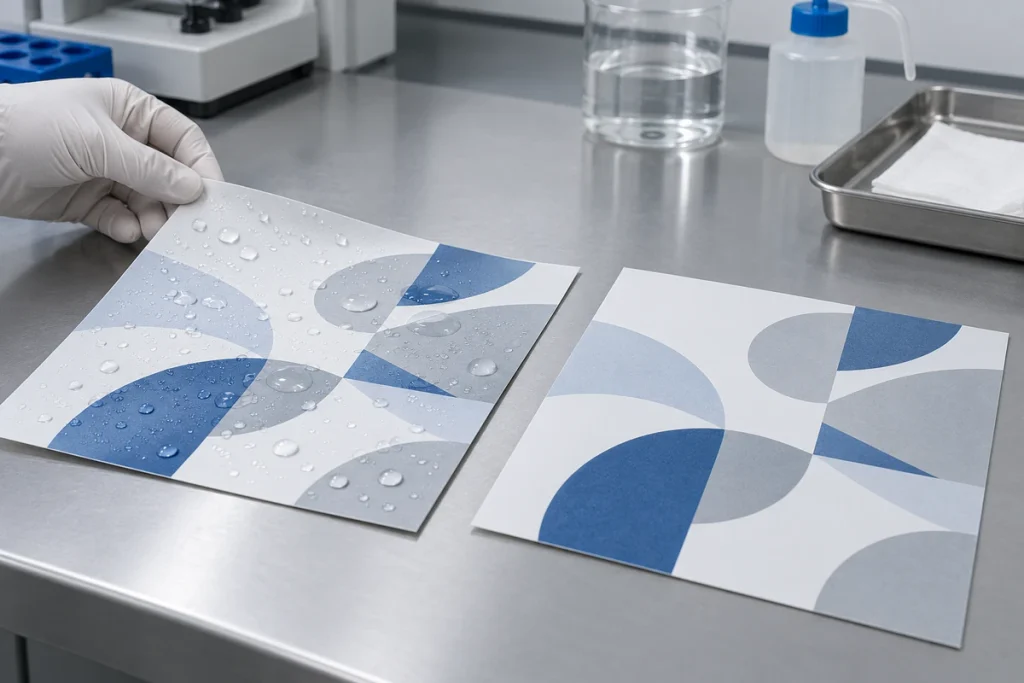
Many synthetic paper substrates resist water without softening or breaking down in the same way as conventional cellulose paper.
However, a water-resistant base material does not automatically make the finished print waterproof.
The finished construction may include:
- Ink or toner
- A printable surface coating
- Varnish or another protective finish
- Adhesive and release liner
- Folds, punched holes, or die-cut features
The substrate may remain intact while the printed image rubs off. A label face may resist moisture while the adhesive lifts from its container.
The appropriate test depends on the application. A brief splash, prolonged immersion, and repeated wet wiping place different demands on the product.
For a restaurant menu, test wiping with the cleaner the customer intends to use. For an outdoor tag, assess wet abrasion and the strength around its attachment hole.
Evaluate the printed and converted item under realistic conditions, rather than relying on a water test of the blank sheet.
Can You Print on Synthetic Paper?
Yes. Synthetic paper can support several printing processes, provided that the grade is compatible with the equipment and ink system.
The description “printable synthetic paper” does not mean the material works on every printer.
| Printing Process | What to Confirm Before Production |
|---|---|
| Conventional offset | Recommended inks, ink setting, fountain solution control, and drying time |
| UV offset or UV flexo | Ink adhesion, curing conditions, and substrate response to heat |
| Water-based flexo | Surface suitability, ink wetting, and drying conditions |
| Screen printing | Ink compatibility, solvent effects, and curing requirements |
| Aqueous inkjet | A receptive surface suitable for the intended dye or pigment ink |
| UV inkjet | Surface compatibility, adhesion, and curing settings |
| Dry toner or laser | Suitability for the specific equipment, fusing conditions, and media thickness |
| Thermal transfer | Ribbon compatibility and printed-image durability |
Synthetic Paper Printing: Surface and Ink Compatibility
Many synthetic papers interact with ink differently from conventional paper.
Depending on the construction, ink may need to adhere to a treated surface or interact with a functional coating. The drying and setting behavior can therefore differ from what a printer expects with cellulose stock.
Before production, ask the supplier:
- Which printing processes does this grade support?
- Are both sides printable?
- Does the grade require a dedicated ink or primer?
- What drying or curing conditions are recommended?
Do not apply a single drying time or ink recommendation to all synthetic papers.
Digital Printing on Synthetic Paper: Match the Grade to the Printer
“Digital printing” covers several distinct technologies.
A material suitable for UV inkjet may not be suitable for aqueous inkjet, dry toner, or liquid electrophotographic printing. Differences in ink chemistry, surface requirements, and operating temperature can affect results.
Provide the exact printer model and ink or toner system when requesting samples. This gives the supplier a clearer basis for recommending a grade.
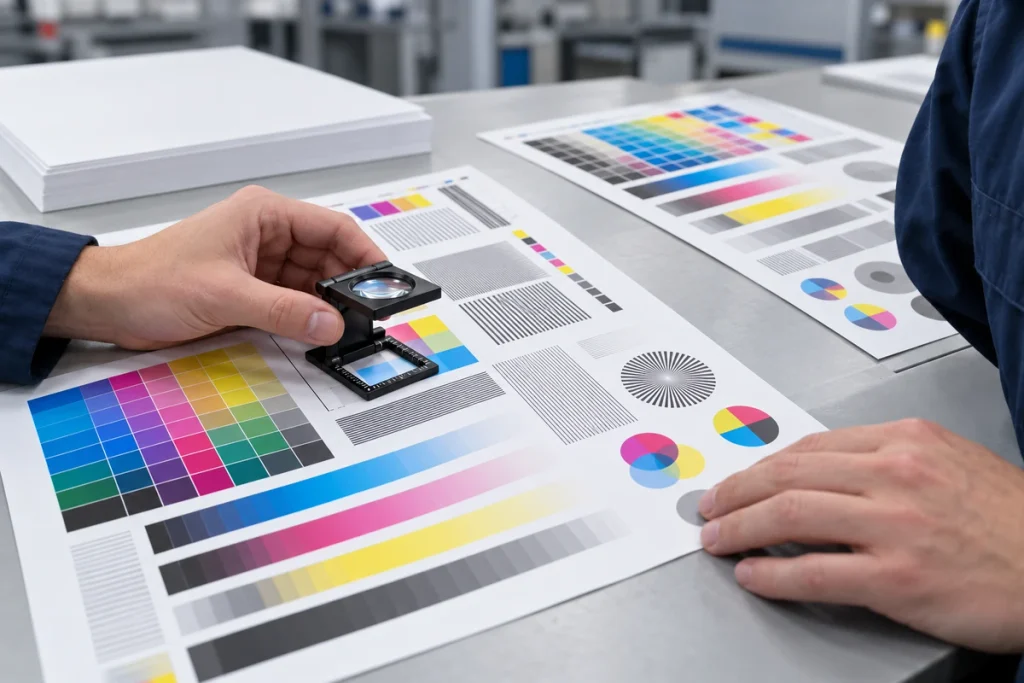
The trial should evaluate both image quality and production behavior, including feeding, duplex printing where required, and handling after printing.
Synthetic paper is commonly considered for printed products exposed to moisture, repeated handling, or demanding service conditions.
What Is Synthetic Paper Used For?
Menus and Reusable Information Cards
Menus, instruction cards, and reusable reference sheets may benefit from a water-resistant substrate.
For synthetic paper for menus, evaluate stiffness, reading clarity, printed-image abrasion, and resistance to the intended cleaning products.
A successful splash test does not establish resistance to repeated cleaning.
Foldable Maps and Outdoor Guides
Maps need a balance between water resistance, readability, and folding performance.
Test the printed sample using the intended fold pattern. Check crease appearance, fold retention, and image durability after repeated opening and closing.
A material that performs well as a flat sheet may behave differently once converted into a compact folded map.
Retail and Industrial Tags
Tags may be exposed to pulling, rubbing, moisture, or repeated movement.
Evaluate the actual tag construction, including punched holes, cut edges, and attachment points. A small notch can affect tear behavior, even when the intact sheet is difficult to tear.
For industrial identification, confirm that important information remains readable after the expected handling and exposure.
Self-Adhesive Labels
Synthetic paper may be used as the face material in a self-adhesive label construction.
However, label performance depends on the face material, adhesive, and release liner working together. The container surface, application temperature, and service environment also influence adhesion.
When choosing self-adhesive label materials, specify the surface to be labeled and whether the product will face moisture, refrigeration, chemicals, or repeated squeezing.
Display Graphics and Durable Manuals
Display graphics and reference documents may require opacity, stiffness, dimensional stability, or resistance to frequent use.
Outdoor applications require additional assessment. Water resistance alone does not establish UV resistance or a guaranteed outdoor lifespan.
What Should Converters Check Before Production?
A successful print trial is only part of material qualification. The substrate must also perform during cutting, folding, feeding, and other finishing operations.
Cutting and Die-Cutting
Evaluate cut quality, dimensional accuracy, die performance, and waste removal using representative production conditions.
For self-adhesive materials, check kiss-cutting and matrix stripping with the complete label construction. Testing the face material alone will not reveal how the adhesive and liner affect converting.
Folding and Creasing
Inspect folded samples for spring-back, stress whitening, damage to the printable surface, and ink cracking along the crease.
Use the intended fold pattern, equipment, and material orientation. Confirm that the finished piece opens, closes, and handles as the customer expects.
Feeding and Static Control
Static can contribute to sheet separation problems, double feeding, or dust attraction.
Assess feeding under normal production conditions. Suitable static-control measures may be necessary, depending on the material, equipment, and environment.
Heat and Web Tension
Roll-fed production exposes the substrate to tension and drying conditions that a small sheet trial may not reproduce.
During the trial, watch for curl, stretching, shrinkage, or registration changes. Confirm the grade’s recommended operating conditions rather than transferring settings from an unrelated stock.
How to Choose Synthetic Paper Rolls or Sheets
Start with the application and production process, then define a purchase specification that the supplier can evaluate.
1. Describe the Service Conditions
Explain how the finished item will be used.
Will it encounter water, cleaning agents, sunlight, cold storage, abrasion, or repeated folding? Where possible, describe the duration and frequency of exposure.
Specific requirements are more useful than a general request for “durable synthetic paper.”
2. Identify the Printing System
Provide the printer or press model, printing method, ink system, and whether the job is printed on one or both sides.
Also mention any primer, varnish, or finishing treatment included in the planned process.
3. Compare Thickness, Stiffness, and Opacity
Synthetic paper is frequently specified by thickness in microns, alongside other technical properties.
Do not select it solely by matching the GSM of conventional paper. Different densities and constructions mean that equal GSM values may produce different thicknesses and handling characteristics.
Compare the properties that affect the application: stiffness for a display card, flexibility for a folded map, or opacity for double-sided printing.
4. Define the Supply Format
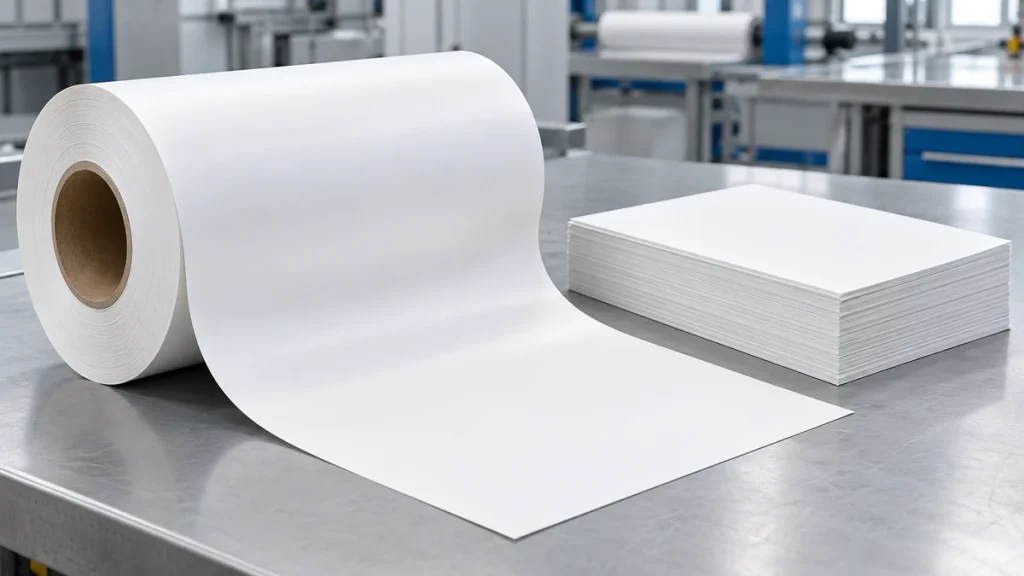
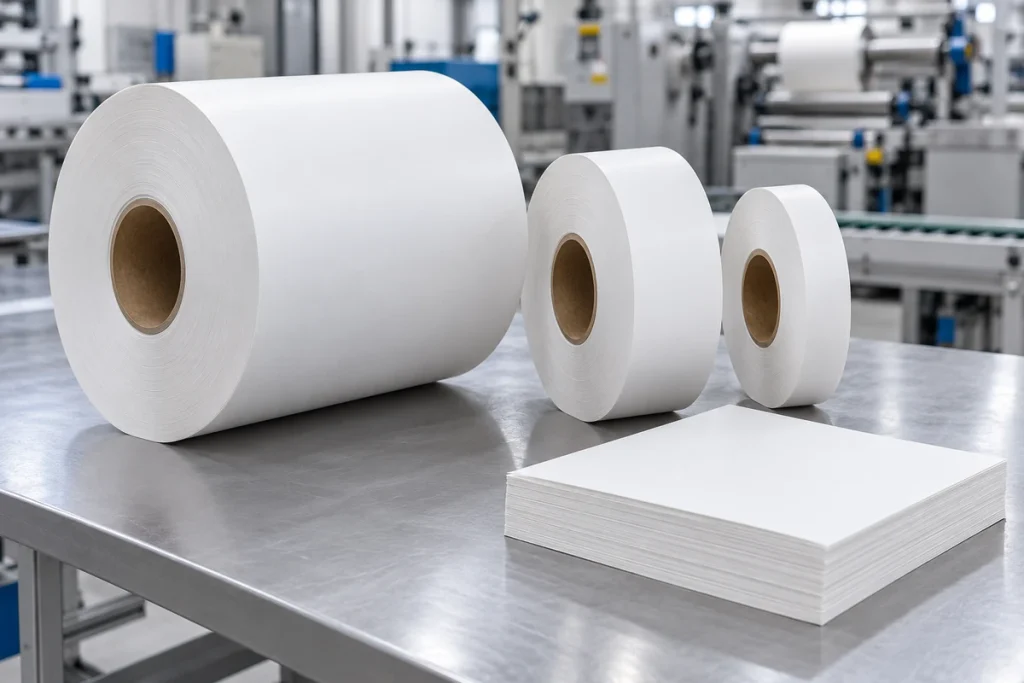
For synthetic paper rolls, confirm:
- Roll width and tolerance
- Roll length or outside diameter
- Core size
- Winding direction
- Printable-side orientation
- Splice requirements
For synthetic paper sheets, confirm sheet dimensions, dimensional tolerances, flatness, any orientation requirements, and packing.
These details affect equipment compatibility, production efficiency, and usable yield.
5. Qualify a Production-Representative Sample
Print the intended artwork and complete the planned finishing steps.
Include demanding features where relevant, such as heavy solids, small text, barcodes, tight folds, and punched holes.
Agree on acceptance criteria before placing a bulk order. The result should establish whether the material works for the job, rather than simply whether the sample looks attractive.
How to Compare the Real Cost of Synthetic Paper
The lowest material price does not always produce the lowest cost per accepted finished item.
A practical comparison should consider:
- Usable material area
- Setup and production waste
- Printing and drying time
- Converting performance
- Protective finishing requirements
- Expected replacement frequency
Use this calculation:
Cost per accepted finished item = Total material and production cost ÷ Number of accepted finished items
When materials differ in thickness or density, compare usable area and finished yield alongside price per kilogram.
This helps buyers assess whether a material saves money across production and use, rather than only at the purchasing stage.
Frequently Asked Questions About Synthetic Paper
Is Synthetic Paper Plastic?
Many synthetic papers are polymer-based materials. They are engineered to provide a paper-like appearance and printing surface, but their composition and processing behavior differ from conventional cellulose paper.
Is Synthetic Paper Tear-Proof?
No universal tear-proof claim applies. Many grades offer improved tear resistance, but performance depends on thickness, construction, orientation, and converted features such as cuts or punched holes.
Can Synthetic Paper Be Used in a Normal Inkjet Printer?
Only if the grade is suitable for that printer and ink system. Aqueous inkjet generally requires an appropriate receptive surface. Do not assume that a general-purpose synthetic paper will accept dye or pigment ink correctly.
Does Synthetic Paper Need Lamination?
Not always. Some applications can use it without lamination. Others may still need a protective finish for abrasion, chemical exposure, or a particular visual effect.
Is Synthetic Paper Recyclable?
Recyclability depends on the polymer, coatings, printed construction, and locally available collection systems. Confirm the appropriate disposal route rather than placing it in conventional paper recycling by default.
What Information Is Needed for a Synthetic Paper Quotation?
Provide the application, printing equipment, ink system, preferred thickness, roll or sheet dimensions, quantity, finishing requirements, and service conditions.
If you are replacing an existing material, include its technical data or a sample where available.
Find the Right Synthetic Paper for Your Printing Process
Choosing synthetic paper starts with understanding what the finished product must do and how it will be produced.
YISHU can discuss material options based on your application, printing process, required dimensions, and expected quantity. Include any requirements for folding, moisture exposure, cleaning, or outdoor use when making an inquiry.
Contact YISHU to discuss your requirements and request samples for printing and converting trials before placing a bulk order.